Aloe habitat and wild flowers in Namaqualand
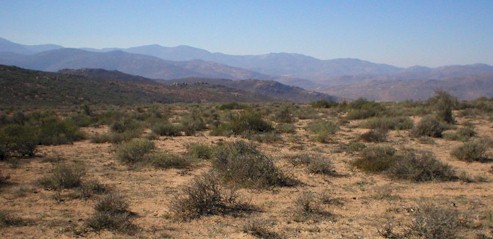
photo above: Namaqualand in summer above
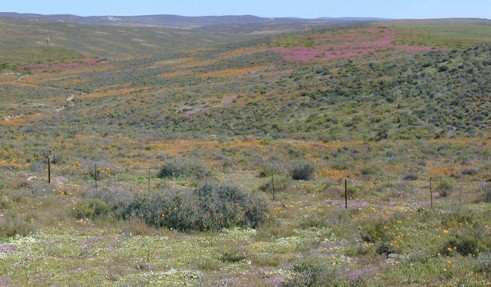
Namaqualand in the winter with splashes of purple mesembs and orange daisies
Most people know Namaqualand as a large flower garden in winter, but that is just one side of the plant world in this part of South Africa. The flowering time last 3-4 months of the year if the flowering time of all the lilies and other plants are included with the daisies and mesembs. All plant life seem dry or dead in dull shades of brown the rest of the year, but most succulent plants are alive in a dormant or semi-dormant state.
I want to show a few photos of Namaqualand (Namakwaland) which are not often seen. Flowering plants and lilies which do not grow in large masses and which are overlooked in the veld with a few photos of the small inhabitants.
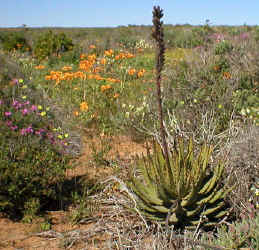
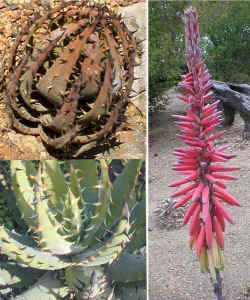
One of the aloes growing in this region is Aloe melanacantha. Aloe melanacantha is impressive with large black thorns on both side of the leaves for protection. The raceme is long with dark pink flowers.
 Aloe melanacantha
with seedpods. Most of the seeds were damaged by the larvae of insects eating them. No food is wasted - the dry season with little to eat is very much longer than the season of plenty.

Photo left:- Aloe melanacantha plant curled up in drought and below the plant opens up in the rain season showing new growth with white thorns. On the right is the long raceme with dark pink flowers fading colour as they open

A grasshopper on an Cleretum sp., ice-plant.
 Life goes on.
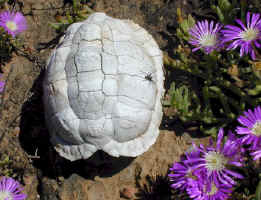
We saw these tortoise skeletons some distance apart, while walking in the veld, August 2006. The skeletons had no injury marks on them which would suggest that the animals died as a result of the drought before the rain season started.


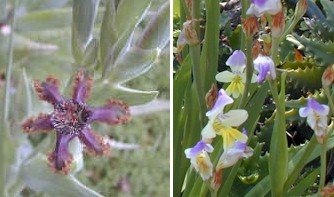
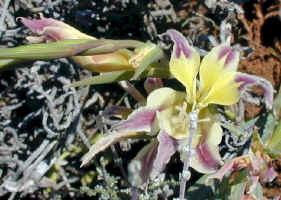
Three of the many beautiful lilies. Above left is a Feraria species and right is Synnotia variegata which is a Gladiolus species. Below is Gladiolus orchidiflorus.


Photo left:- The beetle-daisy invites the beetles with markings on the flowers which resemble beetles. The beetles pollinate the flowers when they visit for nourishment and also to meet their own mates.
In this dry climate where there are no flowers for near to eight months a year, beetles seem to be the main pollinators. The flowering season for the daisies is short. Competition to get pollinators are tough in good rain years when huge areas are covered in thousands of flowers. Any attraction out of the norm will give that plant's flowers an advantage over the rest.
Photo below left:- pretty glittering little lovebugs covered in pollen. They eat nectar which does not harm the flowers in any way. The small longhorn beetle on the photo right, eats the flower pedals, but that is not much for the flower to pay in exchange for pollination.


On the photo left is only one of the "living stones" succulents of the Conophytum species - Some plants in flower. The single plant is about the size of the tip of a lady's finger. The plants go dormant in the dry season protected by a papery covering, which slough off in the rain season as the plants grow and fill up with water. It is very difficult to see them when they are dormant. In the top left corner on the photo are some real stones.