Thursday, August 31, 2006

Aloe ferox medicinal aloe with photos
Aloe ferox has a very wide habitat distribution in South Africa where this aloe has
been used for its medicinal qualities for millennia. Only the gel of Aloe ferox (or any other aloe) should be used by the novice. The sap or bitter yellow exude originating from the green outer cells, can be used for its purgative effects, but it is not recommended as there are better and safer laxatives available.
For more information and recipes on my web site click here http://storm.prohosting.com/farm4u/health.htm
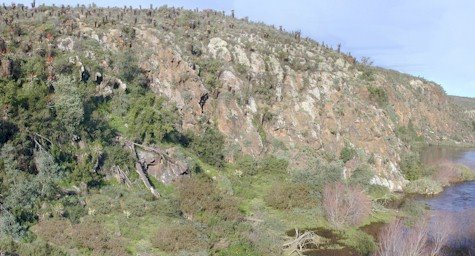


This scene is to the left of the Breede river photo above.


How to prepare the gel
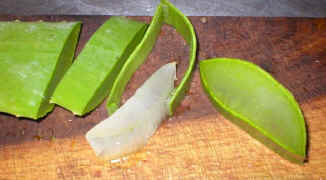


Cut the leaf in portions and peel off the green outer part. The gel is in the translucent leaf pulp. It is not bitter, in fact it is near to tasteless
with only a slight "fresh" taste.


Fresh gel on the skin has a cool feeling. The gel is absorbed by the skin
cells in seconds with only a thin silky layer that remains on the skin, giving the skin a
lovely silk smooth texture. The gel revitalizes the cells and the layer protects the skin
on the outside.

Store the gel in an airtight container in the fridge for a few days only. It is better to freeze the gel in cubes for use and then remove a cube as needed.
The whole leaf can be stored in a cool dry place for a long time, even weeks. Cut off a portion of the leaf as needed.

The gel of most aloes (species or hybrids) can be used, but most aloes does not have much gel. Aloe barbadensis (known as Aloe vera) is well known for its gel. The gel is not as consentrated as the gel of Aloe ferox, but that does not matter. It is easy to cultivate Aloe vera from offshoots.
Aloe vera has been used for about 3000 years. The habitat of this aloe could be Arabia, but it has been cultivated for so long that the origin of this aloe has been lost in time.

Another South African aloe that is very good is Aloe maculata, also known as Aloe saponaria or the common name "soap aloe". The hybrid Aloe maculata x Aloe striata grows faster than Aloe maculata and it has the same high quality gel. The downside is that it is a much smaller plant than A.ferox or A.barbadensis, thus the gel is strictly speaking more expensive, but the gel is the best.

I take a teaspoon gel (mixed with any food or drink, it is tasteless) daily to build my immune system. I also give it to my pregnant cats in their food. I do not like to suggest anything to be taken internally, so please do it on you own risk. Do not take the green skin or sap! A quick rinse after you peeled the gel will remove the sap. A little sap would not hurt. If the gel taste bitter, then there is sap on it. eee-yuk .... do not believe the old tale that it has to taste awful to be good!


Aloe ferox is a large heavy aloe but it blooms from a young age at a relative small size. This easy growing aloe is an excellent focal point for a garden.


for more photos see my garden web site

Saturday, August 5, 2006

Aloe framesii in bloom for the last time ?
Visiting Aloe framesii in bloom each winter and Aloe mitriformis each summer, was on our agenda every year for at least ten years. Aloe framesii blooms the same time as an assortment of winter flowering plants on a small hill in StHelena Bay.
StHelena Bay is on the south western coast of South Africa, where Vasco da Gama landed all those years ago, in his search for the southern point of Africa.


The outings to this quiet bay were always refreshing, but now there is a large wound in "our" hill! That is only the start, the whole hill has been cut up and sold for luxury holiday homes. The sea shore has been bull dozed together with many plants - mesembs, stapeliads, caudiciform plants, euphorbias and more. I do not expect propress to come to halt or something like that, but could Nature Conservation or some other organization not contact plant lovers to remove those plants first ? They fine people for removing plants, but bulldozing? Having said that, I am not going to shout around. My motto is if you do not like it, do something about it, or keep quiet. To tell the truth, I do not have the motivation to organize something so that plants could be saved in future. The people of this country seems to have so many problems, nobody wants more on their shoulders. There may be an energetic nature lover reading this blog who is willing to take on the challenge.


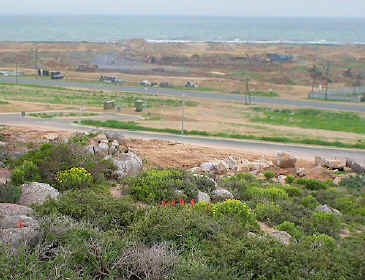
Looking down on progress. Many jobs are created and a lot of people need that badly. If I think of children and families having a better life then it eases the loss.


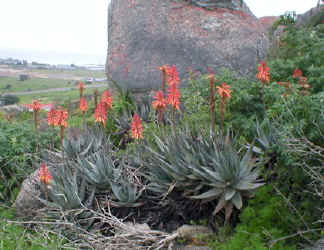
Aloe framesii in bloom. It is a lovely blue aloe. In the summer when all is dry it seems to merge into the blue granite rocks. In winter it needs to be seen by the pollinators and the flowers show off well.


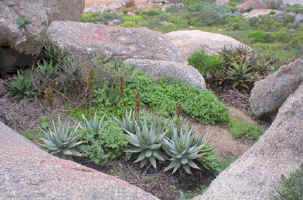
Aloe framesii center front shared this hill with Aloe mitriformis to the back left and right. Aloe mitriformis blooms early summer and Aloe framesii blooms in winter which enabled the two species to grow side by side without hybridizing.

Friday, July 14, 2006

A visit to the Karoo Botanical Garden in Worcester, South Africa.
On our way to the Small Karoo we made a quick stop at the Karoo Botanical Garden in Worcester. No way that we can drive past our favourite garden. As it is, we travel the 250+ kilometre(there and back) to the garden so often, they know us by name.

Photo left shows a very small portion of the botanical garden. I like this portion, it has a natural look and atmosphere. The syphostemmas with their fat naked stems and branches held up towards heaven, always catch my eye. The small flowers blooming between the large plants are gazanias. The very high tree aloe is Aloe barberae.


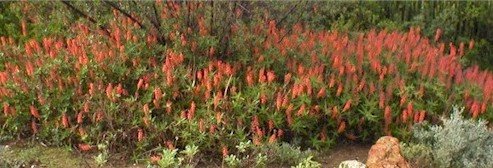
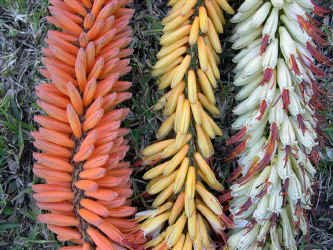
Something special amongst the aloes was the white Aloe ferox photo left and the red Aloe tenuior bush in flower photo below.

A white aloe ferox is scarce. The white Aloe ferox flowers become much lighter as they open and the antlers are maroon-black. A very nice contrast. see photo at the bottom.

Even with seeds from two white Aloe ferox plants, the chance of getting white is very small. It is better to have Aloe ferox with different color flowers growing together and pollinate them all with each other. Then sow 100-200 of those seeds and maybe you will get a few of them blooming white


red Aloe tenuior bush


photo left:- Alexandre Viossat

This photo was not taken in the Karoo Botanical Garden. Alexandre Viossat kindly permitted me to place the photo to show some of the different natural colors in Aloe ferox. These colours were not cultivated, the colours occur naturally in the very large Aloe ferox habitat.

Sunday, July 2, 2006

This excursion into the small Karoo is once more into the drier parts of the country to see some succulents. We were heading for Montagu.

The Klein Karoo will make the heart skip a beat of any person who loves succulent plants.

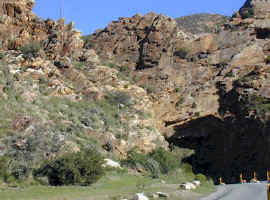
Kogmanspass is just a short tunnel through the mountain. Remarkable as it was built by hand 1876 - 1878


Geological history Kogmanskloof passes through folded layers of the table mountain sandstone in the Langeberge mountains. Rivers deposited the sediment of which these rock were formed along a coastline some 400 to 450 million years ago. Then about 280 million years ago compression forces in the earth's crust began folding the beds for the next 60 million years. Upon this followed forces which formed large crustal fractures roughly parallel to the present coastline. One of the largest of these, the Worcester Fault passes near the southern entrance to the kloof and displaced beds to the south of it downward by several kilometers. Kogmanskloof is but one of several deep gorges carved through the tough sandstone of the table mountain sandstone by the erosive action of swift flowing rivers for millions of years.


The view immediately out of the tunnel into the Kogmanskloof gorge.
To enlarge the photo click on http://made-in-afrika.com/myblog/Kogmanspass..jpg


It was a lovely winter day on 28 June 2006. This very hot region is greener in winter than in summer. As on most of our winter trips, the misty weather was not very good for photos but very much better than the summer heat for walking and climbing.

Rudi loves the climbing. He is geologist so he is used to climb over rocks just to see what is on the other side of the rock.

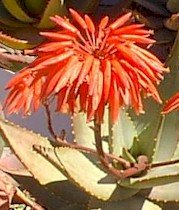
photos below:- The aloes on the slopes are Aloe comptonii.


The very short capitated racemes of Aloe comptonii The leaves are broad and short with blunt teeth.

Sunday, June 18, 2006


Aloe haemanthifolia the rarest of aloes and their natural habitat - This aloe grows high up in the mountains mostly in crevices of cliffs which also gives it the necessary protection against anybody who would like one for some reason.
The trip was the oposite direction from our usual succulent country into the mountains with fynbos vegetation. I do not mind walking on a mountain but driving at speed (any speed faster than a walk) round corners on a wet misty road at a dizzy hight, is not my cup of tea. Rudi had to stop at the look-out spots so that I could unclench my fists and breathe.
A misty morning did not make for the best photo. The proteas were gorgeous. There was many small types and also the well known large pink one.
The rain filtering through the fallen leaves on the ground color the water like tea but I would not advise anybody to drink it! There are many different leaves in that tea and the water is very acid which is what most proteas like.

I would not expect an aloe here anywhere near. Although I know that Aloe plicatilis grows just around the mountain more to the west in the Cape Town area. Aloe plicatilis likes slightly acid to neutral soil and does very well in winter rainfall gardens.
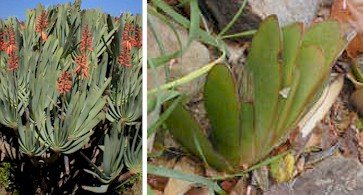
Photo right:
This photo does not give the real impression what this aloe looks like. The thin stiff leaves are large. A foot long (30cm). I would have passed this plant thinking it is a lily of sorts. (The flower would give it away. )
Good news for the colder wet countries. e.g. Canada, UK and Europe. This aloe is for you !
Photo above left:
Aloe plicatilis is a tree aloe with fans instead of the usual rosettes. It would seem that Aloe haemanthifolia is a large fan without the trunk. Aloe plicatilis grows much lower down than Aloe haemanthifolia and in a larger warmer habitat. Aloe plicatilis does not mind water but unlike Aloe haemanthifolia it grows in a frost free area.

Saturday, June 10, 2006


Aloes in containers can make very decorative indoor houseplants. Aloes do well as pot plants because they do not need a lot of soil around the roots. Aloes can be enjoyed as a hobby in pots in a room or on a farm - there is more - a fancy or plain container can make a big change in a garden, in fact a garden can be made entirely in containers or pots only (save on weeding).


Potted aloes can be left without watering for long times, which is very convenient when going on a holiday
Aloe plants which would have been impossible to grow because of cold or too much rain can grow in pots and containers both outside and as indoor houseplants. When the weather is bad the potted aloe plants can be brought indoors for a special effect.


How to plant.
Use normal potting soil and mix with about 50% soil with small stones, broken pottery or the loose pieces of packing material(if light weight is needed) for very good drainage.

The hobby plants, and photo top of page is by Scot Ross
The containers, plants and photo above is from Ben Botha.

Saturday, June 3, 2006


If you want to kill an aloe do it with water, it is not easy to kill an aloe with drought.
The photo above left of Aloe Glauca, an aloe with a beautiful blue rosette, was taken close to two months before the photo on the right. There was a good rain shower two weeks after this photo (left) was taken. Then a month passed and the winter rain arrived with days of rain on and off. The photo above right was taken some 8-10 days after the winter rain began. After the first shower nothing happened visibly but that rain shower and short interval is necessary for the roots to start swelling out and to get ready for the long wet periods that follow the winter rain.
In the few rare years where the winter rain started without a few preceding short showers we always lost some aloes due to rot. If an aloe is water sparingly but evenly all year round, it seldom rot. If the aloes have a long dry period, especialy if the dry period is through a hot summer, watering should be started slowly.
On the photo above to the left of the aloe is Tylecodon. which sent out leaves at the first sign of rain and to the right of Aloe glauca is Aloe ramosissima. It seemed quite all right when it was dry but now that it doubled in size it is obvious that it was shriveled a lot.
Note on the drought photo how the aloe leaves fold over thus protecting the center growing point of the rosette.